Legacy system modernization,
finally worth it

We rebuild legacy business systems on a modern, supported stack. Our engineers work with AI agents, so development takes weeks instead of months and costs less. Then we keep it up to date.

What changed

Until recently, a rebuild was a project companies postponed for years. It doesn’t have to be this way anymore.

Bringing a system that’s many years behind up to date usually means rebuilding it. Our senior engineers and AI agents work as a hybrid team in a defined development process. We can rebuild from existing code, a written specification or the running application.

Development that once took months now takes weeks. Testing and data migration still take time and need your people. We plan for both from day one.

Why it matters

Software ages even when nobody touches it.

Every system is built on technologies with a limited lifespan: programming languages, frameworks, libraries and servers. Their makers maintain them for a few years, then move on. A system that doesn’t keep up still works, but gradually loses support. Often, nobody notices.

A security issue, new regulation, partner integration or urgent feature request exposes the gap. On an up-to-date system, that’s routine maintenance, often done within hours. On a system years behind, it can take weeks, and sometimes there’s no quick fix.

Security
Technologies that are no longer supported stop receiving security updates. If a serious issue appears, there may be no update to install.

Speed of change

Every new feature, integration or AI capability gets harder to add to an old stack, until the answer becomes "we can't".

Compliance

In healthcare, finance and other regulated industries, running unsupported software is hard to defend in an audit.

People

Fewer developers know old frameworks, and fewer want to work on them. Knowledge leaves with the people who built the system.

How it works

Our engineers work with AI agents to rebuild your system on a supported stack, check that it preserves the behaviour your business needs, and plan the data migration with your team.

When we say AI, we don’t mean chatbots or simple assistants writing code. We mean a well-defined process, with experienced engineers reviewing every step.

Legacy source code, database schema and current system behaviour feed AI code analysis and a recovered specification, with every decision confirmed by a human. For each feature, AI agents rebuild on a new stack, run parity tests and review security; a developer reviews the result before the loop repeats. Data migration uses a trial run before going live, followed by acceptance testing with your team and cutover.

Recent projects

A complete SaaS digital product. A core system for a medical clinic. An ERP for a non-standard B2B e-commerce business. A document management system for a mid-sized company.

None of them was simple, and every one of those clients would have said their case was different.
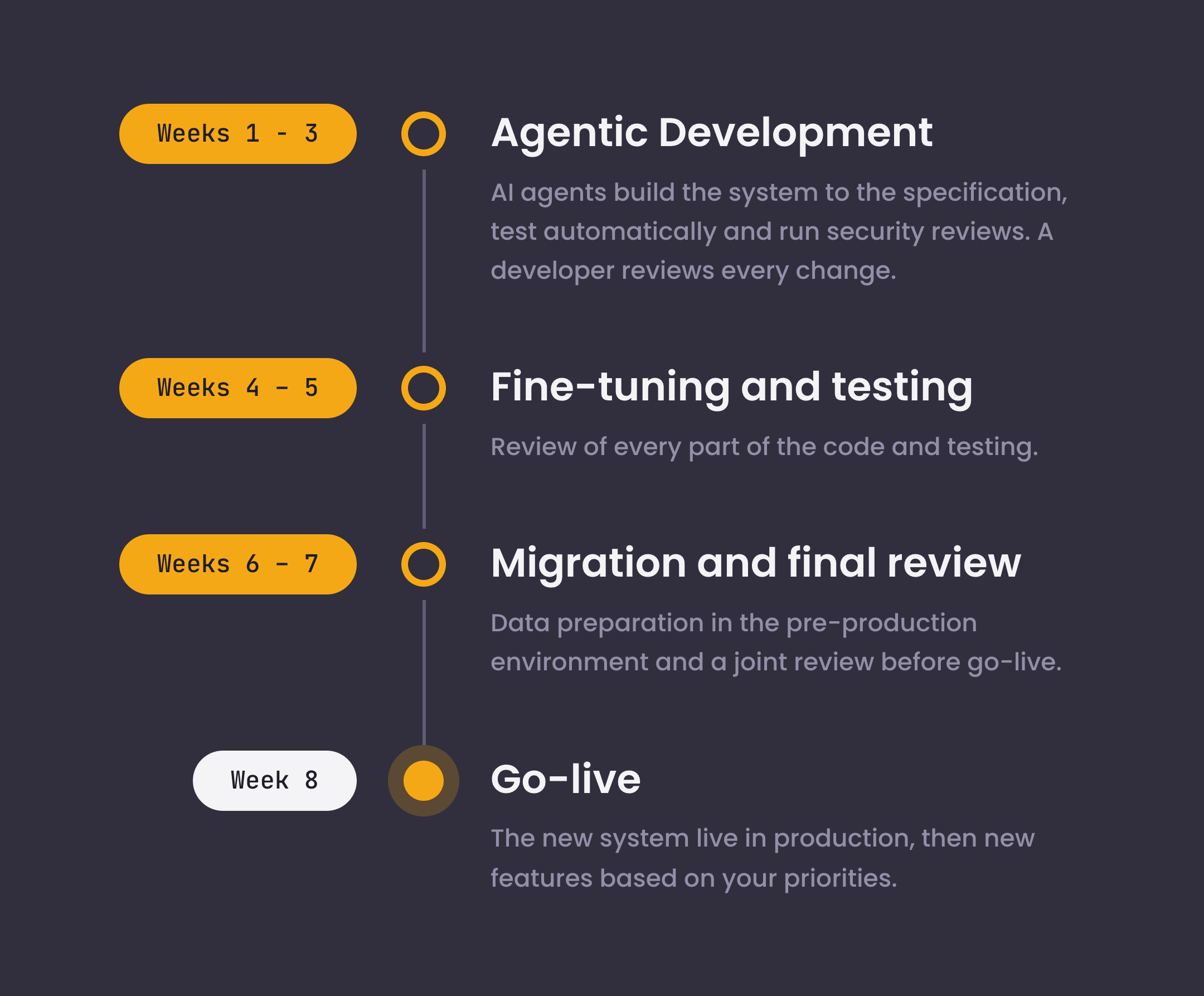
Eight-week ERP project timeline: development in weeks 1–3, testing in weeks 4–5, migration and final review in weeks 6–7, and go-live in week 8.
An example of a real proposal for a mid-sized ERP system: eight weeks, compared with an estimated six months using traditional development.

Modernize once, then stay current

The goal isn't just a new system. It's a system that never falls this far behind again.

Every project ends on a current, supported stack, and our maintenance agreements include regular upgrades as standard. Keeping up becomes routine maintenance, not a project.

Who you talk to

Tell Pavol what you're running and what worries you about it. You'll get an honest view of what's possible, how long it would take, and whether it makes sense to do it now.

Pavol Perdík

Pavol Perdík

CEO

Connects the dots between business problems and product decisions. The one clients call when they're stuck.

Common questions

If even a small change turns into weeks of work and a large bill, or you keep getting told that changes can't be made, it's worth a closer look. A system running on technology its makers no longer support is already legacy. If you're unsure where yours stands, we can start there on the call.

It makes the work faster and cheaper, but it's not a hard requirement. We can also rebuild from the running application and its documentation.

For systems many years behind, usually a rebuild on a modern stack. For systems closer to current, a step-by-step upgrade may be enough. We tell you which after the first conversation.

Most systems we modernize are complex and specific to the business (ERP, CRM, DMS and other business-critical internal systems). Complexity affects the timeline, not whether it can be done.

Development typically takes weeks, not months. Testing and data migration come on top of that. You get a realistic timeline before anything starts.

Little during development. Your people are needed for decisions, testing and checking the migrated data. That part doesn't disappear.

Yes. You keep using it until the new one is tested and your data is moved, then you switch over.

When it's built in a defined process, yes. Senior engineers review every change, and the result meets the same standards as anything else we hand over.

Regular updates are part of our maintenance agreement, so the system stays up to date.

Book a call with Pavol. If you'd like a deeper look at your code first, we also offer a free code audit.

Running something old? Let's talk about it.
Book a call with Pavol